
Brass Bound Bulletin #9: Your kid's playlist is a math class in disguise
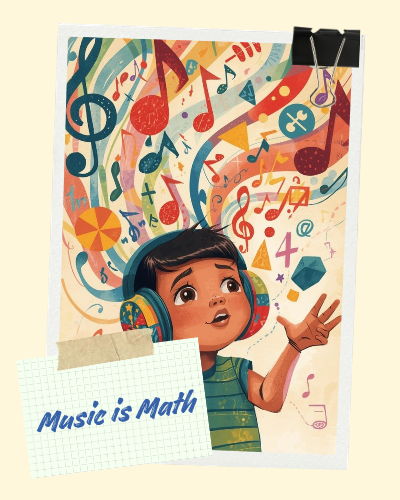
Picture this: You are in the kitchen cooking dinner. Your child is there with you and isn't interested in tonight's "science" lesson (see last week's blog.. :) ) Your kid starts drumming on the table. First softly, then loader as they get into it. After a minute you turn to tell them to stop... but you don't. You stop and listen. Tour child isn't just drumming randomly. They've found a pattern in the drumming. They've found a RHYTHM! Instead of stopping them you hand them a pair of chopsticks and start singing along. JAM SESSION!!!
Music isn't just the "A" in STEAM, it leans HEAVY into the "M" too. Music is straight up math! Don't believe me? Let's take a look at that beat.

Take a look at the image above. See what I see? Fractions! One whole note equals two half notes which equals four quarter notes and so on. They are literally dividing fractions! Whenever a kid claps to a rhythm... they are doing an equation! Try this, have your kid tap out a beat and count it out while they do. Like this "one and two and three and four..." They just learned eighth notes and division! Music teachers do this all the time (I'm looking at you Rhodes.)
Another aspect of music that is akin to pretty much all STEAM? Patterns! Patterns are everywhere! Lyrics, bars, stanzas, it's all patterns. And recognizing it is what our brains are designed to do. This is especially true in 7-11 year olds and ADHD brains are wired to do it FAST! But pattern recognition is useful in a lot of places. Coding uses patterns all the time. It's one of the first skills you use when learning about loops. "Where does my code repeat in such a way that I can use a loop instead?" How about math? Yep! (a + b)(a + b)(a + b)? Nope! (a+b)^3... Heck, even notes are balanced mathematically. Think about it. Why do established chords sound good while random notes played together don't? MATH! The scale is a ration. It's everywhere!
What about physics? Can you say "sound waves?" I knew that you could. Quick experiment, stretch a rubber band and pluck it. Now change the tension and do it again. How does the sound change? Why does that happen? Why is an acoustic guitar hollow? And on that note... (see what I did there...)
Here's some fun engineering experiments: have your kids make musical instruments. How would you do it? What would you need? Have them study the real thing and then have them build one out of whatever they have. Two plastic plates, rubber bands and a paint stir stick? How about a PVC pipe? Ooh! A couple of glasses, chopsticks and some water! While they are building, talk to them about the why. Have them create hypotheses and then test them! It's not just about the learning. It's about making something that sounds cool. That's motivation right there!
But music goes beyond the mental side of STEAM. There's an emotional component to this stuff as well. Learning an instrument is hard. Learning to play it well? Even harder. Getting there takes time. It takes determination. It takes failing over and over again until you get it RIGHT! That's called resilience. Because you learn more from your failures than your successes so challenge yourself, mess up, DO IT AGAIN!
So back to the kitchen... your kid is drumming away. You're singing, maybe wailing on some air guitar and it's a good time. But it's also a learning time... or at least it could be. Take the moments to realize how much you are surrounded by STEAM learning opportunities. Whether it's cooking or the impromptu forming of the 6:00 rock dinner experience.


Comments